


When it comes to recycling efficiency, the type of plastic crusher you choose has a direct impact on how well the rest of your line performs. A properly matched crusher keeps production steady and maintenance costs predictable. A poor match leads to frequent jams and ongoing operational disruptions.
That’s why purchase decisions should begin with a clear look at operating conditions. Material types, labor capacity, output requirements, and budget all play a role in determining the right equipment.
Start With the Plastic You Process Most Often
In most plastic recycling facilities, the feedstock is not consistent. It can range from thin-walled packaging to rigid molded parts, with varying levels of contamination. A crusher designed for lightweight containers may struggle with dense industrial scrap. And a system built for brittle materials may wear faster or clog when exposed to tougher, more irregular inputs.
This is where many facilities lose time and money. They buy equipment for a broad category, like plastic waste, rather than matching the machine to the specific materials and contamination levels they see on the floor. A better fit at the front supports consistent production at every stage that follows.
Consider Consistent Throughput
High throughput always looks good on paper. However, a peak number that only holds under ideal conditions doesn’t necessarily mean higher production numbers. Steady throughput, or how much you produce under typical conditions, is the more important figure.
A good plastic crusher should process material at a pace your line can sustain without constant stops. If the machine feeds unevenly or needs frequent intervention to clear jams, your effective output drops fast. That problem gets worse if downstream equipment has to wait for material or deal with wide swings in feed volume.
Instead of focusing on peak capacity, ask how the machine performs with mixed loads and long production hours. A crusher that runs predictably will usually deliver better efficiency than one with a higher top-end number that struggles with variation.
Look for Size Consistency
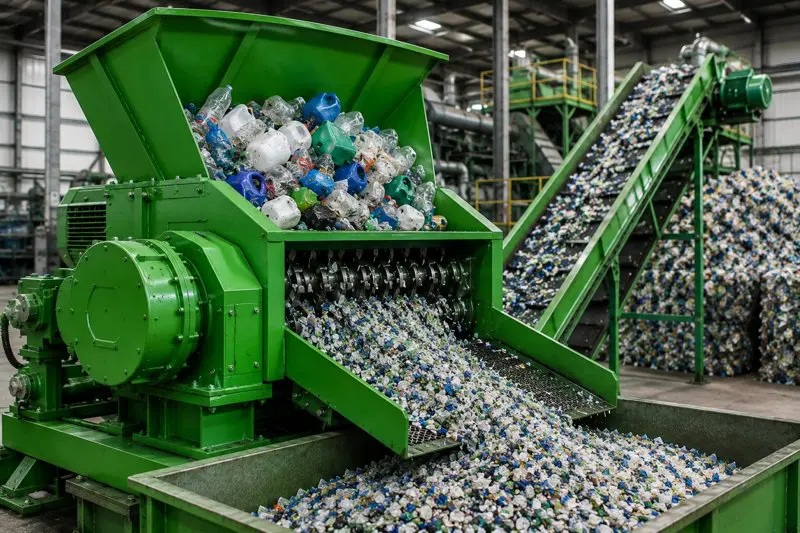
A crusher may reduce material size, but it also sets up everything that follows. If output size is inconsistent, washing and separation become harder to control and the rest of your line has to compensate.
Buyers want material that is predictable and easy to process. If your crushed plastic varies too much in size, it can lower the value of the finished product or force extra screening and reprocessing.
The right crusher helps you produce a feedstock that behaves consistently from the start. Buyers notice that consistency, and it often determines whether your material commands a better price or gets pushed to lower-value applications.
Prioritize Maintenance Access
Maintenance is not a separate consideration from performance. Recycling equipment that is difficult to service will interrupt production more often than one that is easy to access and keep running.
When you compare plastic crushers, look closely at service access. How easy is it to inspect cutters, change screens, and replace wear parts? If those tasks take too long, downtime grows even when the maintenance itself is straightforward. That lost time has a direct effect on operating costs.
Wear rates matter too. Some machines look affordable at the start but carry higher operating costs because cutters dull quickly or parts are difficult to source. A better machine earns its value through easier service and more predictable wear.
Ask About Energy Efficiency
Energy cost stays with you for the life of the machine. That makes efficiency an important selection factor, especially if you run multiple shifts or high volumes.
A crusher that uses power more efficiently can lower operating cost without sacrificing output. This often comes down to motor control, load handling, and how well the machine stays within its intended working range. If the crusher struggles with your material and draws excess power to keep moving, that cost to process material rises.
You should also look at how the machine handles changes in load. Stable energy use under real operating conditions is usually a better sign than a strong performance number based only on ideal feedstock.
Seek to Keep Dust and Noise Minimal
It is easy to overlook dust and noise during equipment selection. However, if the crusher generates too much dust, it increases cleanup demands and puts pressure on extraction systems. It can also accelerate wear around motors and controls over time.
A well-designed machine keeps the surrounding environment more manageable. Cleaner operation supports safer work areas and reduces fine material buildup around motors, controls, and downstream equipment.
These details may not drive the initial purchase, but they have a real effect on how smoothly your facility runs after installation.
Ask Questions That Reflect Your Operation
The best buying decision usually comes from asking the right questions:
- What plastics do you process most often, and how variable is the feed?
- How consistent does your crushed output need to be for the next step?
- How much downtime can your operation tolerate?
- How easy will the machine be for your team to maintain?
- What will an industrial plastic crusher cost to run over a full production year?
Having the right information before you buy will save you from making a decision based on specs alone that may not meet your specific needs.
The Right Crusher
A plastic crusher should fit the system around it. It should feed the next stage properly and align with the material quality your buyers expect. When you get those conditions right, you invest in equipment that supports the whole line rather than just one stage of it.
Start with the crusher that matches how your facility works and watch efficiency and throughput build from there.